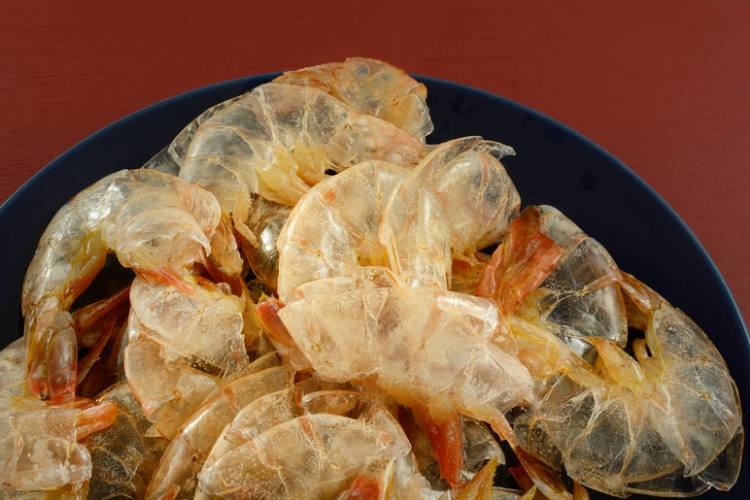
 At seafood plants, shells arrive the way tides do: predictably, relentlessly, and in volumes that make “reuse” sound like a moral instruction rather than an engineering problem. Shrimp peel piles up. Crab carapaces stack. The material is hard to store, expensive to move, and left unmanaged turns into odor, pests, and disposal costs.
Pacific Seafood’s own language for this universe is blunt and operational: “rest protein.” In its 2024 CSR report, the company says it’s pursuing a 100% fish utilization goal by transforming “bones, skin, and shells” into products like fish meals and oil, fertilizer, and pet food inputs, and that in 2024 it prevented 49,114,703 pounds of residual protein from entering U.S. landfills.
That’s the first wave of shell value: keep it out of landfills, turn it into something sellable, move on.
The second wave, the one researchers and materials companies keep circling, is more ambitious: treat the shell not as a nuisance to manage, but as a feedstock for biopolymers. The star molecule is chitin, and its better-known derivative, chitosan, is a family of materials that can become everything from water-treatment sorbents to packaging films to biomedical scaffolds.
The catch is the part nobody puts on a sustainability poster: scaling chitin is a supply-chain, chemistry, and permitting puzzle. If you want a “chitin refinery,” you don’t just need shells. You need clean shells, consistent shells, the right extraction method, a plan for the chemical and wastewater streams, and customers willing to pay for tight specifications.
Table of Contents
What Chitin Is and Why Shell Is the Obvious (And Complicated) Source
Chitin is often described as the second most abundant natural biopolymer after cellulose. It’s a tough, nitrogen-containing polysaccharide that helps form the structure of crustacean shells, insect exoskeletons, and fungal cell walls.
For commercial production, crustacean shells dominate for a simple reason: processing creates a concentrated pile of feedstock at an industrial scale. Composition-wise, shells are not “mostly chitin,” they’re a composite. A 2025 Frontiers review summarizes crustacean shell makeup as roughly 15–40% chitin, 20–40% protein, and 20–50% calcium carbonate.
That blend is exactly what makes chitin valuable and exactly what makes extraction hard.
The Raw-Material Scale Is Huge; the Usable Scale Is the Trick
One widely cited estimate (summarized in a 2022 Nature Food perspective) puts global crustacean production at 13.7 million metric tonnes (2015) and suggests this yields 6–8 million metric tonnes of lobster, crab, and shrimp wastes annually.
Those numbers are big enough to make anyone dream of new industries. But they hide the real constraint: shells are messy, variable, seasonal, and geographically uneven. A chitin plant needs year-round throughput and predictable composition. Seafood waste streams don’t naturally behave that way without deliberate upstream design: segregation, rapid chilling, contamination control, and stabilized storage.
This is where Pacific’s “rest protein” framing becomes relevant beyond PR: if a company is already tracking and routing tens of millions of pounds of byproduct, it’s building the muscles you’d need for a higher-value shell pipeline.
The Extraction Reality: Chitin Isn’t “Recycled,” It’s Refined
Most industrial chitin/chitosan production is, at heart, a separation problem:
- Demineralize (remove calcium carbonate)
- Deproteinize (remove proteins)
- Optionally decolorize (remove pigments)
- Deacetylate chitin → chitosan (for certain applications)
A 2025 Frontiers overview describes the conventional approach bluntly: “classical methods” often rely on strong acids and alkali for demineralization and deproteinization, with alternatives including enzymes, ionic liquids, and deep eutectic solvents designed to reduce harsh chemistry and preserve polymer quality.
That’s the scaling fork in the road:
- Chemical extraction scales are well understood, but can generate significant salt/alkaline wastewater streams and require careful EHS design.
- Greener methods (fermentation, enzymes, novel solvents) can reduce environmental burden and improve functionality, but often face throughput, cost, or solvent-recovery hurdles when pushed to commodity volumes.
This is why one Nature Food discussion of “shell refinery” pipelines calls out the need for multi-million-dollar investment to build integrated processing that can recover chitin alongside minerals, proteins, and pigments rather than treating everything but chitin as waste.
Where the “Materials” Story Gets Real
If chitin were only destined for low-margin uses, it wouldn’t justify refinery-level complexity. The frontier is being pushed by applications that pay for performance and purity.
1) Packaging and Barrier Films
Chitosan’s film-forming ability and antimicrobial properties are widely cited as promising for food-contact coatings and packaging, especially as brands chase biodegradable and compostable materials. Reviews routinely point to chitin/chitosan’s biodegradability and biocompatibility as reasons it keeps showing up in materials roadmaps.
Scaling challenge: food-contact uses are spec-heavy odor, allergen control, residual chemistry, and batch consistency, all of which become gating items.
2) Water Treatment and Remediation
Chitosan is commonly explored as an adsorbent/flocculant for contaminants because of its functional groups and modifiability; a range of peer-reviewed work covers this landscape.
Scaling challenge: water-treatment customers want cheap, consistent, easy-to-handle products. A biopolymer has to compete on delivered cost, not just novelty.
3) Agriculture and Biostimulants
Chitin-derived products (and chitosan) are studied for plant health and disease resistance, including use as functional biopolymers that can reduce reliance on synthetic agrochemicals.
Scaling challenge: field performance is variable; regulatory pathways differ by claim (soil amendment vs pesticide vs biostimulant), and supply contracts can be seasonal, just like the shells.
4) Advanced Materials (Nanofibers, Composites, Even Electronics-Adjacent Research)
The “moonshot” framing is that chitin can be processed into high-performance nanomaterials used in advanced applications; Nature Food explicitly mentions chitin-based advanced nanomaterials for “fully biobased electric devices” as an emerging direction.
Scaling challenge: making nanomaterials at consistent quality while keeping costs and solvent recovery under control is hard even in mature industries.
The Pacific Seafood Angle: Today’s Shell Systems, Tomorrow’s Chitin Option
Pacific Seafood’s 2024 CSR report doesn’t claim it’s producing chitin biopolymers. What it does show is that the company is already building systems that would matter if it chose to go there: massive byproduct diversion, and cross-country shell logistics when a restoration program needed substrate.
That second example, shipping millions of Pacific oyster shells to Maryland for reef creation, also clarifies an important scientific point: not all “shell” is a chitin shell. Oyster shells are primarily calcium carbonate and are often most valuable as reef substrate or soil amendment; the “chitin frontier” is mostly about crustacean shells (shrimp/crab/lobster), where chitin is a meaningful fraction of dry mass.
In other words, Pacific’s current shell story is largely circular logistics and reuse, and chitin would be refining and chemical engineering layered on top.
What It Would Take To Scale: A Practical Checklist
If a journalist had to summarize the “chitin refinery” scaling challenge in one sentence, it’d be this: you’re building a chemical plant whose feedstock is seasonal seafood waste. The credible path to scale usually needs all of the following:
1) Feedstock Contracts + Segregation Rules
You don’t want a shell stream mixed with trash, line, labels, or excessive organic residue. The difference between high-value polymer and low-value meal can be decided at the dock.
2) Stabilization and Storage
Shell must be handled so it doesn’t become an odor and pathogen issue, and so the chitin isn’t degraded by microbial activity before processing.
3) Process Choice With a Wastewater Plan
If you use traditional acid/alkali methods, you need robust neutralization and wastewater treatment. If you use newer solvent systems, you need solvent recovery and EHS evidence that the “green” process really is green at scale.
4) Co-Product Strategy
Shell isn’t just chitin. It’s also calcium carbonate, proteins, and pigments. The economics improve dramatically when you can monetize more than one output, exactly the kind of integrated “shell refinery” logic researchers argue for.
5) a Spec-Driven Market With Long-Term Off-Take
Chitosan is not a single commodity; it’s a ladder of grades (molecular weight, degree of deacetylation, ash content, viscosity). Customers pay for specs, and specs require QA.
6) Permitting, Safety, and Community License
Chitin scaling is industrial: chemicals, tanks, emissions controls, and trucking. “Circular economy” doesn’t exempt a facility from being a facility.
The Bottom Line: Shells Will Keep Moving; the Question Is Whether They’ll Keep Upgrading
Pacific Seafood’s CSR quantifies something most companies only gesture toward: byproducts are already being handled at an enormous scale, 49,114,703 pounds diverted in a year. Today, much of that value is captured through established outlets (meal, oil, fertilizer, and pet inputs). The chitin frontier argues there’s another rung on the ladder: higher-margin materials, if the industry can solve the refinery problems, feedstock consistency, process chemistry, co-products, and markets that reward quality.
Chitin isn’t “the next oyster reef” kind of story, visible, photogenic, easy to celebrate. It’s a mechanical-room story. Pipes, tanks, specs, and permits.
Which is exactly why, if it scales, it will matter.