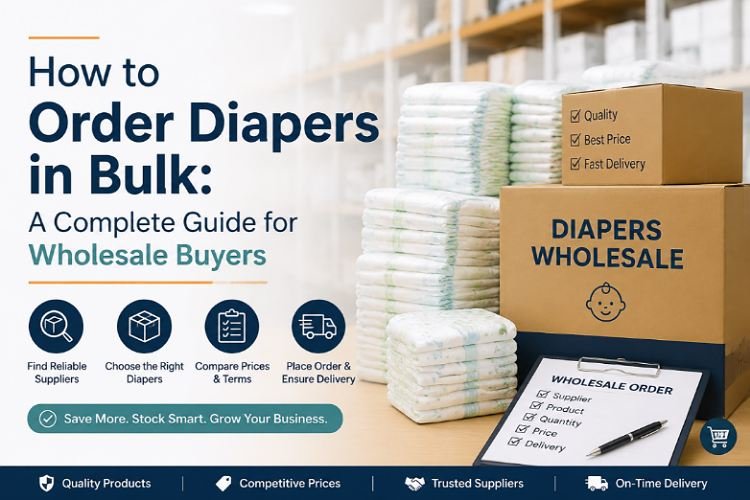
 Diapers are high-demand consumer products with steady sales across supermarkets, pharmacies, baby stores, healthcare channels, and online marketplaces. For distributors, wholesalers, retailers, and private-label brands, buying diapers in bulk can significantly reduce unit costs while creating a more stable supply chain.
However, bulk diaper purchasing involves more than simply finding the lowest price. Product quality, absorbency, sizing, packaging, production capacity, customization, and delivery reliability can all affect your business.
This guide explains the main ways to order diapers in bulk and what buyers should consider before placing a large-volume order.
Table of Contents
1. Buy Directly From Diaper Manufacturers
One of the most common sourcing methods is purchasing directly from a diaper manufacturer.
This approach is especially suitable for importers, distributors, wholesalers, and brands that require large quantities. By working directly with a factory, buyers can often access factory-level pricing while gaining more control over product specifications.
Manufacturers may also provide customization options such as:
- Diaper sizes
- Absorbency levels
- SAP and fluff pulp configurations
- Top sheet and back sheet materials
- Elastic waist designs
- Packaging quantities
- Private-label branding
- Custom packaging
For businesses planning repeat orders, direct factory sourcing can also make production planning and supply management easier.
2. Source Diapers From China
China is one of the major sourcing destinations for disposable hygiene products. Buyers can find manufacturers producing baby diapers, pull-up pants, adult diapers, underpads, sanitary products, and related hygiene products.
Businesses looking for long-term supply can consider ordering from a reliable diaper supplier in China that supports wholesale, OEM/ODM, and private-label cooperation.
For example, Tianzheng provides baby and adult diaper manufacturing together with customized design, packaging, private-label production, material customization, and large-volume wholesale support.
This sourcing model can be particularly useful for companies that want to build their own diaper brand rather than simply resell an existing brand.
3. Work With Wholesale Distributors
Another option is purchasing through local or regional diaper wholesalers.
Compared with direct factory sourcing, wholesalers usually offer smaller order quantities and faster local delivery. They may also carry multiple brands, sizes, and product types in the same warehouse.
This approach works well for:
- Small retailers
- Pharmacies
- Local baby stores
- Nursing homes
- Small e-commerce sellers
- Businesses testing a new market
The main disadvantage is cost. Because distributors add their own margins, the unit price may be higher than buying directly from a manufacturer.
4. Use B2B Sourcing Platforms
International B2B marketplaces provide another convenient way to find diaper suppliers.
Buyers can search for manufacturers, compare products, request quotations, and contact multiple suppliers relatively quickly.
However, a supplier profile alone should not determine your purchasing decision. Before placing a large order, verify the manufacturer’s actual production capabilities, quality-control procedures, export experience, product specifications, and business credentials.
Requesting samples before bulk purchasing is also highly recommended.
5. Consider Private-Label Diaper Manufacturing
Private-label manufacturing is increasingly attractive for businesses that want to develop their own diaper brands.
Instead of investing in production lines, machinery, materials, and manufacturing staff, a company can work with an established diaper factory to manufacture products under its own brand.
Depending on the manufacturer, customization may include product structure, absorbency, softness, packaging, logo printing, package quantities, and other specifications.
This allows businesses to focus more resources on branding, distribution, marketing, and customer acquisition.
What to Check Before Placing a Bulk Diaper Order
Price matters, but it should never be the only factor.
Before confirming a large order, buyers should evaluate several key areas:
Product Quality: Check softness, breathability, absorption speed, liquid retention, rewet performance, leakage protection, and overall fit.
Materials: Ask about the nonwoven fabric, SAP, fluff pulp, elastic materials, adhesives, and back sheet used in production.
Samples: Test actual samples before approving mass production. A product that looks good in photos may perform differently in real use.
Production Capacity: Make sure the factory can support your expected purchasing volume, especially if you plan regular container orders.
Quality Consistency: Large buyers need consistent performance between production batches. Significant changes in thickness, absorption, softness, or sizing can lead to customer complaints.
Customization: If you are developing a private-label brand, confirm what can be customized and whether different specifications affect the MOQ.
Packaging: Check individual pack quantities, carton dimensions, labeling, barcode requirements, and export packaging.
Lead Time: Confirm production and packaging lead times before planning promotions, inventory replenishment, or product launches.
Request Samples Before Large-Volume Purchasing
A sample order is one of the most important steps in diaper sourcing.
Test several sizes and specifications rather than evaluating only one product. Pay attention to absorption, softness, leakage protection, elastic recovery, adhesive performance, and overall construction.
If possible, compare samples from several suppliers under the same testing conditions.
This process may take extra time at the beginning, but it can prevent expensive problems after thousands of packages have already been produced.
Calculate the Total Landed Cost
The factory price is only part of the real purchasing cost.
International buyers should also consider:
Total Landed Cost = Product Cost + Packaging + Inland Transportation + Export Costs + International Freight + Import Duties + Local Delivery
A supplier offering a slightly higher factory price may ultimately provide better value through improved container loading, consistent quality, lower defect rates, or more reliable production.
For large-volume purchasing, even small differences in logistics efficiency can have a meaningful impact on profit margins.
Build a Long-Term Supplier Relationship
If diapers are a core product category for your business, supplier stability becomes increasingly important as your sales grow.
A reliable manufacturing partner should be able to maintain consistent product specifications, communicate clearly, plan repeat production, support packaging updates, and respond when market requirements change.
Many buyers begin with samples or trial orders before moving to larger wholesale orders. This gradual approach allows both sides to verify product quality, communication efficiency, and delivery performance before committing to long-term cooperation.
Conclusion
There are several ways to order diapers in bulk, including purchasing from manufacturers, wholesalers, B2B platforms, and private-label suppliers.
For smaller quantities, local wholesalers may offer greater flexibility. For importers, distributors, and brands purchasing larger volumes, direct cooperation with a manufacturer can provide stronger advantages in pricing, customization, production control, and long-term supply.
Before placing a large order, compare suppliers carefully, request samples, verify product specifications, calculate the total landed cost, and evaluate the manufacturer’s ability to maintain consistent quality.
Choosing the right supplier is not simply about getting a lower price. It is about building a supply chain that can support your business as order volumes grow.